
Bremerton National Airport | Port of Bremerton
Commercial Air Service and Cargo Feasibility Study Open House
September 2026 update
Welcome and Overview
Since July 2024, the Port of Bremerton has been exploring the feasibility of introducing limited commercial passenger or cargo service at Bremerton National Airport (PWT). This analysis is in response to community interest, and in keeping with our mission to increase economic development and improve local quality of life.
In March 2025, the Port Commission directed Port staff to continue studying the feasibility of providing limited commercial passenger service at PWT. This additional study would also examine
key questions the community told the Port it wanted explored concerning new service at the airport.
What’s new in 2026?
The Port’s consultant team has spent the past 18 months conducting studies and working with the Federal Aviation Administration (FAA) to understand what changes PWT would need to make to pass FAA certification. These studies have included traffic and noise analyses which our community has requested.
In September 2026 the consultant team is presenting these findings to the Port Commission and to the public. We hope you will review the new information on this site and take our survey. The Commission will consider your feedback in its decision about whether the Port should continue pursuing commercial passenger service by engaging with local, state, and federal funding partners.
How close is PWT to commercial passenger service and what would it look like?
The short answer is that service is not imminent and even if the Port pursues funding for infrastructure improvements it is not guaranteed.
Bremerton National Airport needs infrastructure improvements to obtain FAA certification and to attract a carrier. The most likely commercial passenger service scenario would be a low-cost carrier operating less-than-daily flights to select domestic destinations. Should demand prove sufficient, that service could grow over 10-20 years to more frequent service and more airlines.
Under all scenarios, PWT would continue to offer general and corporate aviation services.
How would PWT change with commercial passenger service?
Today Bremerton National Airport does not meet the FAA’s safety and operational requirements for commercial passenger service. The Port would have to invest in infrastructure improvements to meet those minimum requirements, and then additional improvements to attract a carrier airline.
Three of the big questions we heard from our community last year about commercial passenger service were: how would this change the airport, and what would be the noise and traffic impacts? Read on for the results.
Infrastructure Improvements and Costs
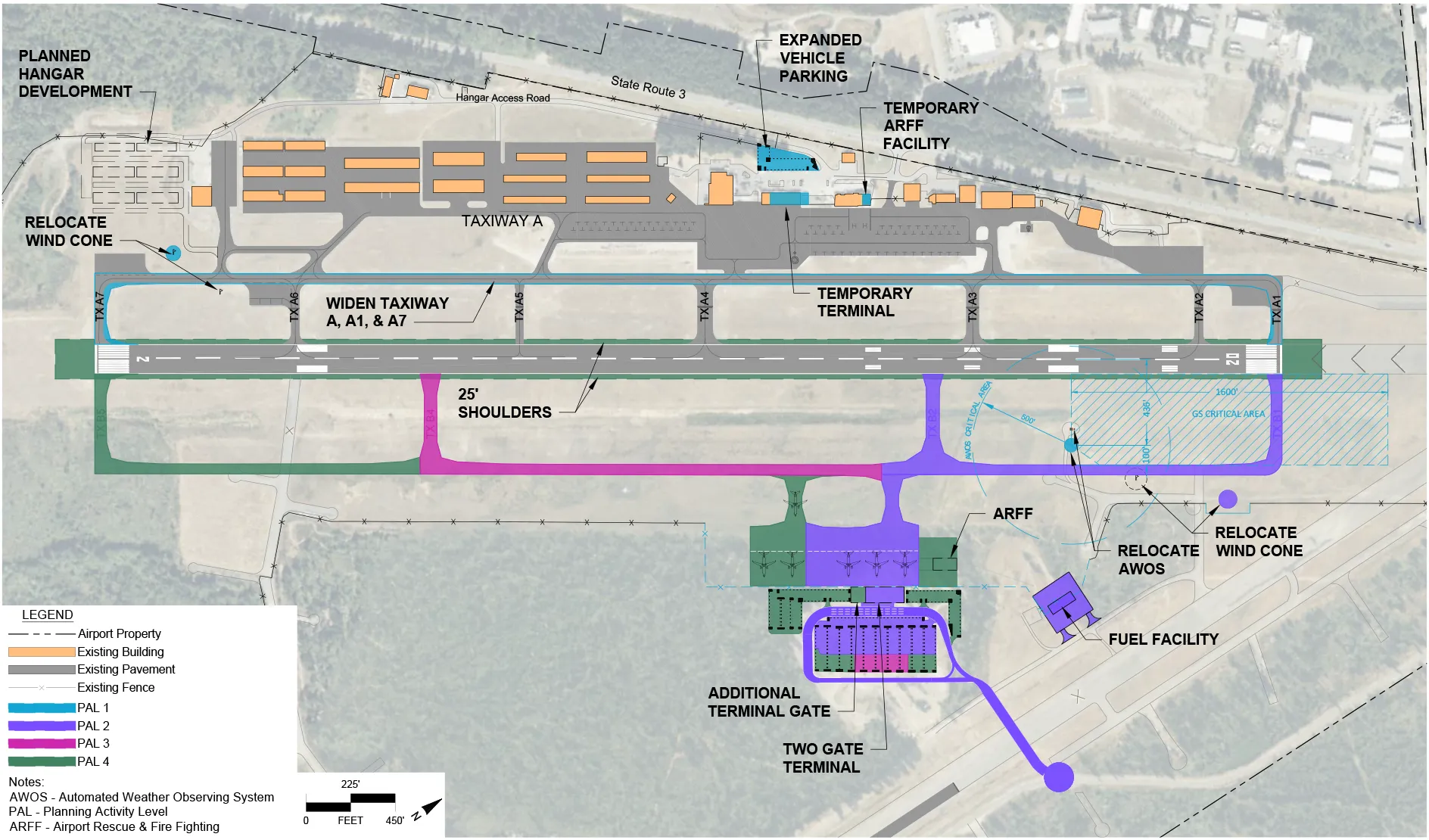
The study modelled changes to airport infrastructure by breaking the work into phases called Planning Activity Levels (PAL). The project team identified four Planning Activity Levels and estimated costs for each. These PAL start from what is necessary to receive initial service, what is needed if service expands and what a full build out in 20 years of expanded service could look like.
What Gets Built
Minimum investment to meet FAA standards for acceptable service. Includes:
- Renovate Port Office building into a terminal
- Expand vehicle parking near terminal
- Renovate/convert existing hangar to an Aircraft Rescue and Firefighting (ARFF) facility
- Widen taxiways to meet FAA standards
- Build new Air Operations Area fence around terminal
Estimated Cost
$24,034,000
Source: Mix of state, local and other funding sources.
Rough Timeline
If the Port decides to move forward, once funding is acquired.
What Gets Built
Significant investments to support the growth of commercial service operations. Includes:
- New terminal on east side of runway with two gates
- New terminal apron, new taxiway to support new terminal
- 250-vehicle parking lot with access road and circulation loop
Estimated Cost
$106,413,000
Source: FAA funding for eligible portion; state and local funding for the remainder.
Rough Timeline
Once the air service market has proven itself, grown to necessitate a new facility and funding is available; likely 5-10+ years out after initial service.
What Gets Built
Improvements to meet increasing passenger and operational demands of successful service. Includes:
- Additional 100 parking spots
- Taxiway extension
Estimated Costs
$12,343,000
Source: FAA funding for eligible portion; state and local funding for the remainder.
Rough Timeline
Based on continued growth and funding availability; likely 10-15 years out after initial service.
What Gets Built
Final projects to represent PWT at full development with commercial service fully established. Includes:
- Expand terminal to add additional gate
- Taxiway and apron expansion
- Additional 150 parking spots
- New ARFF facility
Estimated Cost
$69,401,000
Source: FAA funding for eligible portion; state and local funding for the remainder.
Rough Timeline
Based on continued growth and funding availability; likely 20+ years out after initial service.
Conclusion
A full build-out would only happen if commercial passenger service began and found strong demand. In that scenario (estimated 20+ years in the future) the airport would have constructed and expanded a new terminal on the east side of the runway, built new parking facilities, and improved the airport’s taxiways and other infrastructure. PWT would remain a single-runway airport and all improvements would take place within the current footprint of Bremerton National Airport. No new land would have to be acquired.
Noise
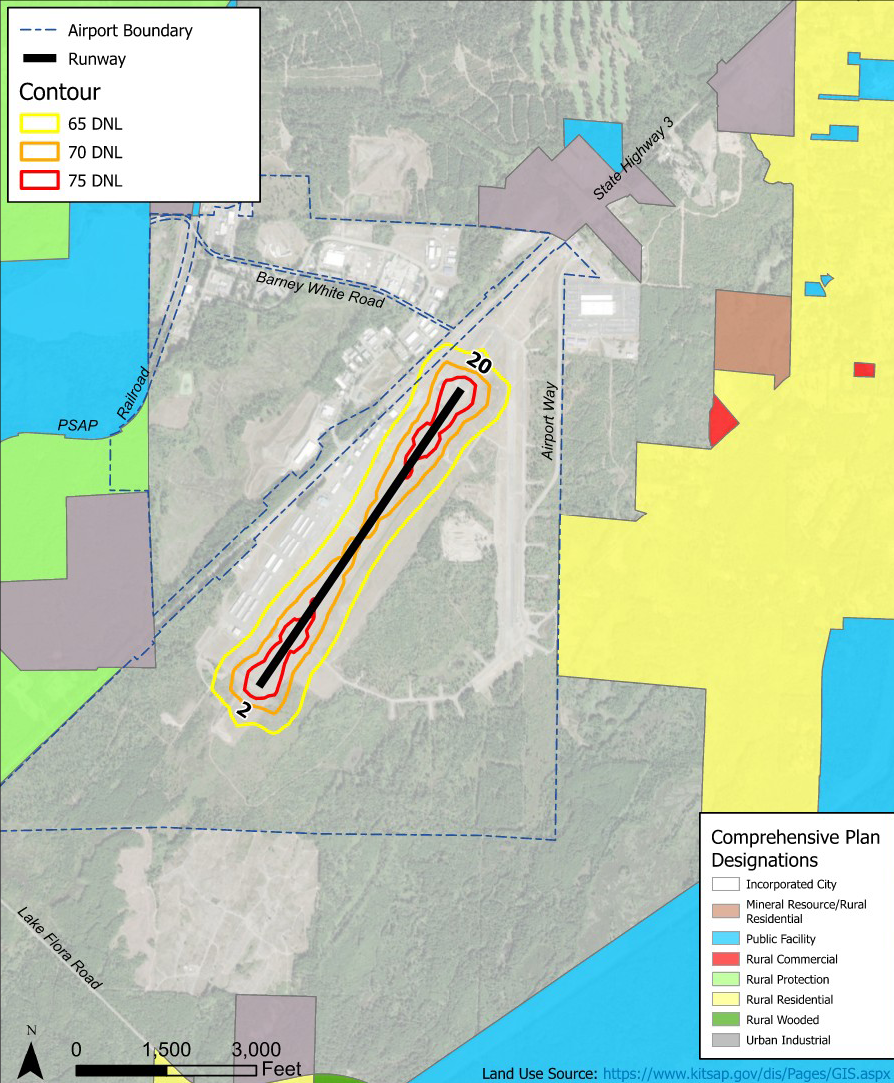
The consultant team measured noise at the airport in 2024 to produce a baseline, then compared that to two scenarios: a future 2044 airport without commercial service, and a 2044 airport with commercial service. This analysis:
- Modelled noise contours around the airport based on the types and quantities of aircraft that would operate at the airport in 2044.
- Assumed the busiest forecasted scenario, which entails a PAL 4 infrastructure build-out and a carrier operating 4-5 daily flights with smaller regional jets (e.g. Embraer E175) and 1-2 daily flights of Boeing 737s or Airbus A320s.
- Used 65 decibels DNL (day-night level)* as the threshold of concern. This is the federal aviation standard; noise above 65 decibels DNL begins to interfere with residential, school, health care and religious land uses.
*DNL represents the annual, 24-hour average sound exposure calculated from the accumulation of all noise events, adding a 10 dB penalty to sound levels occurring between 10 p.m. and 7 a.m.
Conclusion
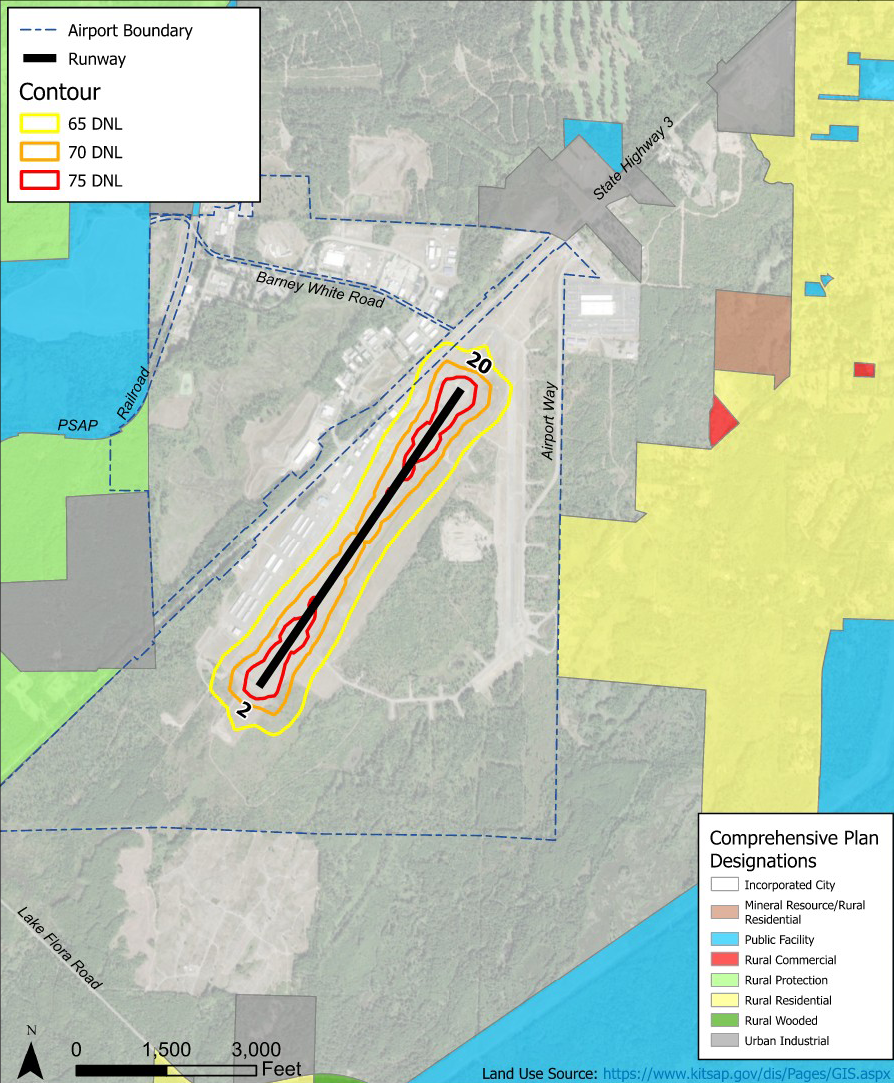
Commercial passenger service would not measurably change the noise contours around the airport. The 65 decibel DNL threshold would reach SR 3 near the airport’s northern boundary but would remain far from any sensitive land uses like homes or schools.
Traffic
The Port does not have a lot of control over SR 3, which is managed by the Washington State Department of Transportation (WSDOT). Our consultant team studied what commercial passenger service might contribute in terms of increased vehicles on the road out to 2050, past the ultimate planning level – Planning Level 4.
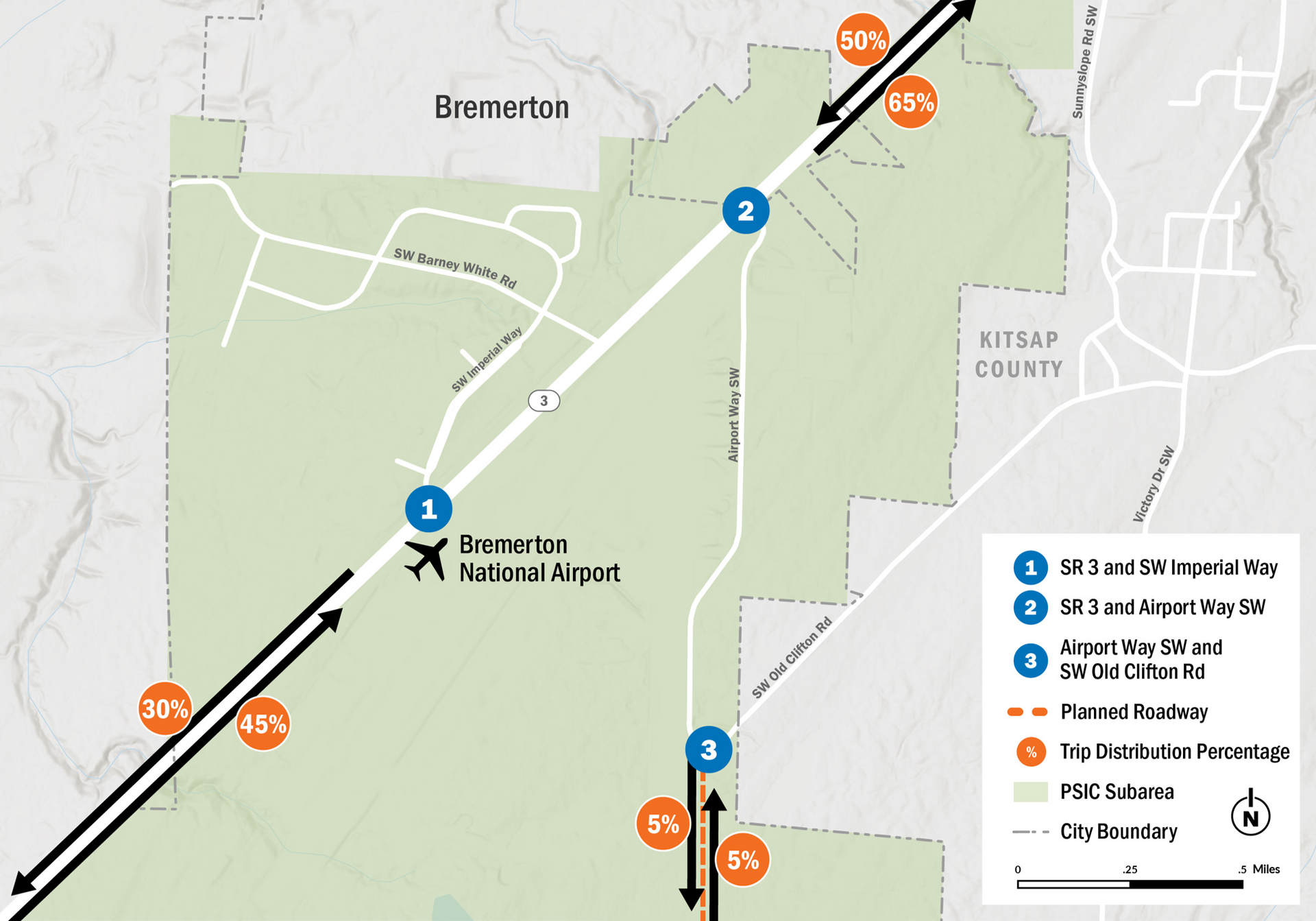
The consultant team studied PM peak hour conditions at three key intersections near the airport, using WSDOT’s Level of Service (LOS) standards to describe how well they operate. The team used data from Kitsap County and City of Bremerton, and reviewed regional and local agency plans, to forecast 2050 roadway conditions both with and without commercial passenger service.
Conclusion
- Commercial air service adds traffic but does not change overall conditions at those intersections.
- Expected regional traffic growth, regardless of airport operations, will increase traffic to the area and queueing at stoplights and roundabouts will remain a system-wide constraint
- Commercial service, at the ultimate planning level — Planning Level 4 — would add roughly 133 vehicles in and out of the airport at the peak PM traffic time. This assumes one flight is boarding while another is deplaning at the same time.
Recommended improvements
- Work with WSDOT to change signal timing at SR 3 / SW Imperial Way.
- Add a westbound right-turn pocket at the airport exit if air service were to remain on the west side of the airfield.
Note: Our study did not examine the potential changes to SR 3 near Bremerton National Airport from WSDOT’s ongoing SR 3 Gorst Area study.
Project Timeline - Phase 1
July 2024
Began market feasibility study
October – November 2024
Online open house and community priorities survey
February 2025
- Commission heard results of feasibility study
- Public information session and web updates
March 2025
Commission voted to move forward with Phase 2 (commercial passenger only)
Phase 2
September 2025 – Summer 2026
- Study noise impacts and local and highway traffic impacts to Highway 3
- Identify infrastructure needs, rough costs, and potential funding sources
- Investigate community needs and impacts
September 2026
- Share Phase 2 findings at 9/8 Commission meeting and open house
- Online open house and digital survey open 9/8 – 9/29
Fall 2026
- Compile all feedback into a summary to present to the Board of Commissioners
- Commission votes on whether to explore funding and additional study
Future work – if approved by Commissioners
2027-2029
- Study Phase 3 working on building local, state and federal financial support for the initial projects.
2029-2030s (If funding is Identified)
- Environmental (NEPA) process (includes additional community input)
- Design and construction
TBD
- Start of new service (dependent upon many factors, including carrier interest and airport readiness)
What Comes Next?
Thank you to everyone who took our survey! If you missed the survey window (Sept 8 - Sept 29), you can still share your thoughts directly with the Port by emailing us at airportstudy@portofbremerton.org.
All survey comments and responses will be shared with the Port's Commission, who will make a decision about whether the Port should continue to pursue commercial passenger service.